


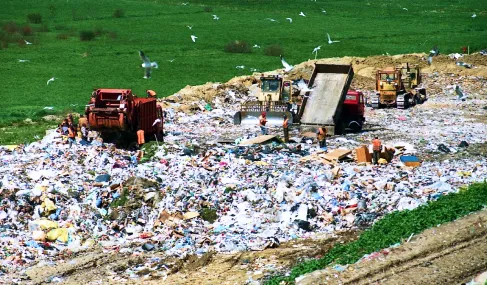


Waste management is now a major environmental and economic issue for Algeria. With more than 13 million tonnes of household and similar waste produced every year, the country has considerable potential for recovering, recycling and reusing secondary raw materials.
Yet turning this waste into resources requires an organised chain: sorting at source, collection, transport, preparation and supply to processing plants.
For businesses, this is a real opportunity. Waste from offices, shops and industrial sites can become recoverable material, provided it is properly separated and collected.
- Where does recycling in Algeria really stand?
- Which materials have the greatest potential?
- What is holding the sector back?
- How can businesses take part in this transformation?
The waste market in Algeria: the figures to know
To understand the outlook for recycling, we first need to look at the volumes of waste produced nationwide.
According to statements by an official of the National Waste Agency (AND), reported in March 2025, Algeria generated about 13.4 million tonnes of household and similar waste in 2024.
13.4 Mt
Household & similar waste
Generated in Algeria in 2024
53%
Organic matter
Potential for biological recovery and composting
15%
Plastics
Estimated share of the waste composition
DZD 200 bn
Economic value
Estimated annual value of recoverable waste
17,000
Potential jobs
Estimate linked to developing PET plastic collection
Source: AND statements reported by Horizons, 18 March 2025.
These figures show that waste is a significant economic resource. They also highlight the need for infrastructure and mechanisms able to turn this potential into materials that are actually recovered.
How much waste does each person produce?
According to the National Waste Agency's report for 2020, average national production of household and similar waste was about 0.80 kg per person per day. In the wilaya of Algiers, the average reached about 0.90 kg per person per day.
National average
0.80 kg
per person per day
Wilaya of Algiers
0.90 kg
per person per day
That is a considerable daily flow nationwide, and an opportunity for businesses that want to organise the recovery of the materials their activities produce.
Plastic in Algeria: a high-potential sector
Plastic is one of the main challenges in developing recycling in Algeria.
According to the National Waste Agency's report on plastic waste, waste containing plastic resins was estimated at 2.1 million tonnes in 2018, out of 13.1 million tonnes of waste in total. Citing a 2020 AND study, the same report put the recovery rate for plastics at about 15%.

2.1 Mt
Waste containing plastic resins
2018 estimate
15%
Estimated recovery rate
AND study, 2020
So the key question is not only how to recycle plastic, but above all how to secure a regular supply of quality raw material.
Several categories are of particular interest:
Water and drink bottles and food packaging compatible with recycling channels.
Jerrycans, bottles and some rigid containers.
Flexible packaging and industrial film, depending on composition and condition.
Each category needs specific collection, storage and preparation conditions. For manufacturers, the availability of clean, properly sorted and consolidated material is decisive for keeping production running.
How Nrecycli Office helps
Our sorting stations separate PET, HDPE, paper-cardboard and aluminium right in your offices, so material leaves clean and sorted for the right recycling channel, with no extra effort from your teams.
The economic value of waste: an opportunity for Algeria's economy
Recycling is not only an environmental benefit. It also creates a new economic value chain.
In January 2024, National Waste Agency officials reported that more than 5,000 businesses were registered in household and similar waste management activities at the end of 2023, covering transport, recovery, sorting, reprocessing and recycling. The market value of the waste produced in 2023 was then estimated at more than DZD 200 billion.
This activity involves several types of players:
- 1
Waste producers
Generate recyclable materials
Your company - 2
Collectors
Recovery and consolidation
- 3
Hauliers
Transport of materials
- 4
Sorting centres
Separation and preparation
- 5
Recyclers
Processing into secondary material
- 6
Manufacturers
Reuse in production
Developing this chain requires better coordination between waste producers, collectors and processing plants.
This is where businesses can play a strategic role: they are regular sources of recyclable materials, provided their waste is properly sorted and collected.
Why is collection the main challenge for recycling?
Having processing plants is not enough to build an effective recycling sector. A plant may have the right equipment, but without a regular supply of raw material its output stays limited.
The problem often lies upstream of processing. Four issues matter most.
4.1
Scattered sources
Recyclables are produced at thousands of sites: companies, shops, public offices, schools and households. Recovering them requires a collection network able to cover all these points.
4.2
Quality of recovered materials
Plastic mixed with organic or other waste may need extra cleaning and separation. The quality of the initial sort directly determines the quality of the secondary material.
4.3
Logistics cost
Collecting small quantities from distant sites can be expensive. Volumes need to be consolidated, routes optimised and pickup frequency adjusted.
4.4
Lack of traceability
Without reliable data, it is hard to know the quantities actually recovered, their origin, quality and destination. Digitising collection and tracking is a key lever for structuring the sector.
How Nrecycli Office helps
These four challenges are exactly what we handle for you: sorting at source in your premises, shared collection rounds sized to your volumes, and full traceability of every pickup with EcoTracker.
Businesses: a key link in developing recycling
Businesses produce paper, cardboard, plastic and metal every day, all of which can be recovered.
Unlike scattered sources, business waste has an advantage: its origin is usually identifiable and its production fairly regular.
Simulating a business waste stream
Illustrative assumption: a company with 200 employees, each generating an average of 100 g of recyclable paper and cardboard per working day, 22 working days per month.
20 kg
per day
440 kg
per month
5.28 t
per year

This example shows that a single site can be a worthwhile source when it has a suitable sorting and collection system.
Across several hundred companies, pooling these volumes helps build more regular and better organised material flows.
That is why business recycling programmes should be seen as part of the supply chain for recycling industries.
How Nrecycli Office helps
How much recyclable material does your company generate? Contact us: we estimate your volumes and size the right setup for your headcount and premises.
How does Nrecycli Office support businesses?
To meet these challenges, Nrecycli Office offers an integrated approach to managing recyclable waste in businesses.
We support organisations through every stage of their recycling programme, from identifying the materials they produce to tracking collection operations.
- 1
Audit and sorting set-up
Every company has specific needs. We help you identify recyclable materials, assess available space and size the equipment you need, for a setup that fits your activity and constraints.
- 2
Professional sorting equipment
A range of solutions to separate materials at source, make sorting easy for employees and simplify pickups:
- Indoor loopers
- Single-, dual- and triple-stream sorting stations
- Customisable equipment
- High-capacity containers
- Indoor and outdoor solutions
- 3
Collection of recyclables
Pickups are scheduled according to volumes, site location and collection needs, sending each stream to the right recycling channel. Accepted materials:
- PET plastic
- HDPE plastic
- Paper and cardboard
- Aluminium and accepted non-ferrous metals
- 4
Employee awareness
A recycling programme succeeds when the people using the equipment every day take part. We support the roll-out with station installation, sorting instructions and awareness sessions, to make sorting a lasting daily habit.
- 5
EcoTracker: measure and track your environmental performance
A digital tool to track collection and recovery performance, understand your results and document your CSR commitments:
- Quantities collected per material
- Trends in recovered volumes
- Estimated environmental impact indicators
- Data for your environmental reports
- 6
A digital platform to make things simple
Explore our solutions and get an instant quote online. For specific needs, our team can run an on-site audit to study your volumes, operational constraints and equipment needs.
Get my quote
Our approach: make every operation visible, measurable and verifiable.
What model for developing recycling in Algeria?
Developing recycling means going beyond simply building processing centres. We need an ecosystem that connects waste producers with collection operators and manufacturers. An effective model rests on three pillars:
Organise the flows
Separate materials by category and adapt recovery channels.
Improve quality
Limit contamination and improve packaging.
Connect supply and demand
Match collected volumes with the real needs of manufacturers and recyclers.
This approach gradually moves from scattered waste management to genuinely organised flows of recyclable materials.
Turning waste into resources starts with better organisation
The available data show that Algeria has a large stock of recoverable materials. With more than 13 million tonnes of household and similar waste generated in 2024 and an estimated economic value of over DZD 200 billion, developing recycling is a major issue for the national circular economy.
Unlocking this potential depends above all on organising collection, improving the quality of recovered materials and securing a regular supply for processing industries. Businesses have a key role to play.
Through our sorting, collection, awareness and EcoTracker traceability solutions, we help organisations set up structured recycling programmes that fit their needs and can be measured over time.
At Nrecycli Office, we believe every company can become an active link in the circular economy.